Geopolitical Tensions and the Rise of the Dynamic Value Chain

March 8, 2026

Designing Aligned Supply Chains for a Geopolitically Fragmented World

Geopolitical Tensions and the Rise of the Dynamic Value Chain


Global supply chains have entered a phase of sustained instability or persistent volatility. Trade fragmentation, regional conflict, sanctions, industrial policy, and energy insecurity are no longer temporary disruptions but have become a permanent design variable in today’s operating environment.  The resulting disruptions are not anomalies to be absorbed; they are signals that the logic underpinning many value chains is outdated they are structural characteristics of the contemporary operating environment.¹ For senior leaders, the central challenge is no longer restoring stability, but sustaining value creation under conditions of persistent uncertainty. This shift exposes a fundamental misalignment. Many value chains remain designed for a geopolitical context that no longer exists.


From Efficiency to Fit in a Fractured World when Optimization Stops Working


For decades, value chains were optimized around cost efficiency, scale, and predictability. These designs reflected assumptions of open markets, relatively neutral geopolitics, and stable trade regimes. Geopolitical tensions have reshaped flows of materials, capital, data, and talent. Near-shoring and “friend-shoring” alter cost structures. Export controls constrain technology access. Centralized networks and long planning horizons were logical outcomes of this environment.²


Those assumptions have eroded. Access to materials, technology, and markets is increasingly shaped by political alignment rather than comparative advantage alone. Logistics routes can be disrupted or repriced with little notice, and regulatory regimes now vary sharply across regions.³ The result is a widening gap between how value chains are configured and what markets require. Emphasizing that traditional, one-size-fits-all supply chains—optimized primarily for cost—are ill-suited for this environment. The Dynamic Value Chain reframes the problem: value is not created by efficiency alone, but by continuous alignment between customer demand, behaviours, strategic intent, and supply chain configuration.


The Dynamic Value Chain addresses this gap by shifting the focus from efficiency to continuous alignment—between demand characteristics, strategic intent, and supply chain design. This approach resonates strongly with the supply alignment philosophy advanced by John Gattorna, who rejected the notion of a single optimal supply chain in favour of deliberately differentiated configurations matched to distinct demand behaviours.⁴⁻⁵


Geopolitics as a Demand-Side Force, Not Just a Risk to Supply


Geopolitical tension is frequently treated as a supply-side risk to be mitigated. However, its more consequential impact lies in how it reshapes demand.  Across industries, customers and institutional buyers increasingly prioritize continuity, transparency, and compliance over lowest cost. Regional responsiveness, compliance, traceability, and sovereignty considerations now influence purchasing decisions alongside traditional service metrics.⁶ These shifts fragment demand. A value chain optimized for cost efficiency will systematically underperform in segments that value reliability and assurance, while resilience-oriented configurations may be uncompetitive in price-sensitive markets. Averaging these trade-offs across the enterprise erodes value on both sides.⁷ Dynamic Value Chains explicitly recognize this tension and respond by segmenting demand first, then aligning supply capabilities accordingly. In short, across markets, customers and institutions are redefining what they value:

  • Security of Supply, reliability and continuity increasingly outweigh lowest cost
  • Transparency, traceability, and compliance are non-negotiable strategic requirements
  • Increased clock speed and regional responsiveness command a premium
  • Sovereignty and resilience influence purchasing and policy decisions


DVC framework alignment:

  • Design principle: Strategic fit over universal optimization through Demand-driven segmentation,
  • Primary capability: Structural adaptability across value chain configurations through behavioural alignment between customers and supply chains


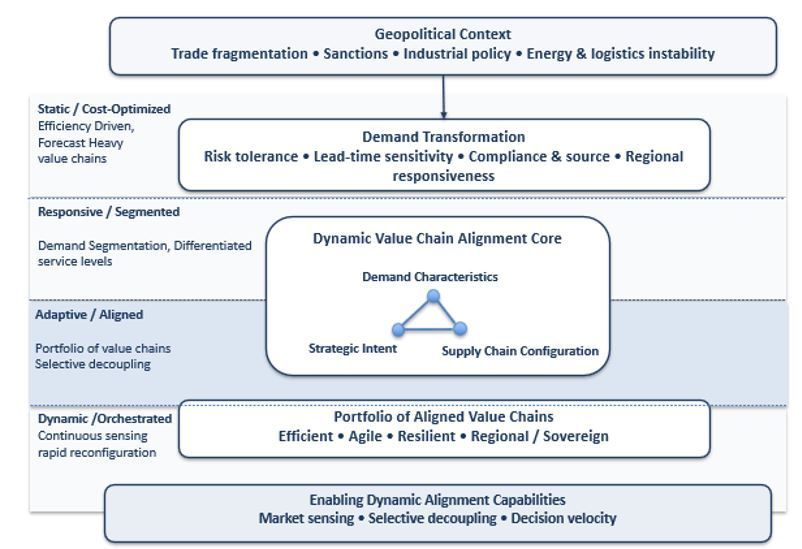
Dynamic Value Chain Maturity Layers (Conceptual Logic) Figure at bottom of the blog Illustrates the Dynamic Value Chain (DVC) framework, positioning geopolitical tension as a structural context that reshapes demand characteristics and necessitates continuous alignment between demand, strategic intent, and supply chain configuration. The framework emphasizes portfolio-based value chain design enabled by dynamic alignment capabilities, including market sensing, selective decoupling, and decision velocity.


From One Network to a Portfolio of Value Chains - Managing a Portfolio of Value Chains

In the spirit of the alignment models that emphasize to converge on a critical insight: competitive advantage increasingly depends on managing a portfolio of differentiated value chains, rather than a single global network. That can be translated into five adaptive levers:

  1. Market sensing over forecasting - In geopolitically volatile environments, historical data loses predictive power. Continuous sensing of policy shifts, border friction, energy volatility, and customer priorities becomes essential.⁸ DVC capability: Adaptive intelligence
  2. Demand-first segmentation - Segmentation must extend beyond volume and margin to include tolerance for risk, lead time, compliance, and disruption. Supply chain design should follow segmentation, not precede it.⁴ DVC capability: Strategic segmentation logic
  3. Portfolio thinking, not single networks - Organizations must operate a portfolio of supply chains: resilient, agile, lean, or fully localized—each matched to a specific value proposition. DVC capability: tailored value proposition per supply chain
  4. Selective decoupling - Strategic buffers, postponed differentiation, and modular architectures allow organizations to absorb shocks where uncertainty concentrates without excessive redundancy.²  DVC capability: Structural resilience by design
  5. Decision velocity as a strategic asset - Governance, data visibility, and cross-functional coordination determine how rapidly value chains can be reconfigured. In dynamic environments, speed of alignment becomes a source of competitive advantage.⁹ DVC capability: Execution agility


Value Creation Under Persistent Tension


Geopolitical instability exposes the limits of static, efficiency-driven value chains. Designed for scale and predictability, they are increasingly fragile, relative slow to adapt, and misaligned with customer expectations. Dynamic Value Chains offer an alternative. They treat geopolitical tension not as an external anomaly to be buffered against, but as a permanent design constraint—and, potentially, a source of advantage. The objective is not to eliminate complexity, but to deploy it deliberately, where it creates value. 


The strategic question for leaders has changed. It is no longer how to protect supply chains from geopolitics, but how to design Dynamic Value Chains that remain aligned, adaptive, and competitive because geopolitics is now part of the system.


Endnotes

  1. World Economic Forum, The Global Risks Report 2024 (Geneva: WEF, 2024).
  2. Martin Christopher, Logistics & Supply Chain Management, 5th ed. (Harlow: Pearson Education, 2016).
  3. McKinsey Global Institute, Geopolitics and the Geometry of Global Trade (New York: McKinsey & Company, 2023).
  4. John Gattorna, Living Supply Chains (Upper Saddle River, NJ: FT Press, 2010).
  5. John Gattorna, Dynamic Supply Chains, 2nd ed. (Harlow: Pearson Education, 2015).
  6. Harvard Business Review, “How Geopolitics Is Rewriting the Rules of Global Supply Chains,” 2022.
  7. Yossi Sheffi, The Resilient Enterprise (Cambridge, MA: MIT Press, 2007).
  8. Harvard Business Review, “The End of Forecasting as We Know It,” 2022.
  9. Harvard Business Review, “Why Speed of Decision-Making Is the New Competitive Advantage,” 2023.

By bas August 9, 2020
A few weeks ago, I had the pleasure of attending a session with the famous Olympian Gold medal swimmer from the Netherlands. Who is currently leading Team NL to the next Olympic games in Japan. A session I reflect back on with lots of inspiration on how to manage through uncertainty, whilst enabling an high performance culture. Here my reflections of the conversation.   It starts with an Ambition Slogan, for the Olympic team translated into "Inspire a generation" what people do on the playing field and show off field, is what truly matters to become a champion when the games are not on. In this I see a clear parallel with Business, inspiration from common goal an higher purpose to align the minds.   The postponement of the Olympics, is a big disruption, a great program impacting a team that would have had a peak performance, and aligned all efforts to that specific moment in time. Acknowledge that tailor made solutions are needed for each different situation, i.e. with a year of delay this means that team set-up would or will be changed. Although people qualified to go to the Olympics it might mean that they are over the top, or get injured, or new talent is jumping to take a seat as they will be the best of best next year, different life choices etc.. Acknowledgment off and address these elements upfront, to keep the team motivated. Its start with the core values (together and respect), athletes are more then a gold medal, this requires to be honest and provide upfront with feedback on the situation.   We further discussed the job of the Chef the Mission or any leader, is to create a high-performance culture. One of the Olympic learnings came from the US and Australia. Between the best coaches of all different teams, they started to sharing knowledge from different sports / disciplines / ways of working/ universities to drive a different outcome, i.e. training SMART, next to Hard and take the required rest to recharge. The philosophy is simple, if you are already a top performer and reached a performance plateau, how can you break through? Not by doing more of the same, but by trying new things out from others that have reached a plateau of performance as well.   A key aspect of creating a high performing culture is Working hard every day try, to push each other, great sportsmanship, but pushing performance up. Great example provided was on Kieran and Dorian, the Dutch windsurfers, with only 1 ticket, whilst being best friends, they kept pushing each other up in performance knowing that only one would go, that is true sportsmanship, winning together.   A personal reflection was on the Olympics in Beijing, Swim fast in old fashion way, due to the change in technology i.e. the technology of suits, which Pieter didn't maximise he got 5th in Beijing. Here it was made clear that previous performance didn't count, its not about the best swimmer, but on all aspects around it, the best team, the best selected materials, although he set the best personal time ever, learning is that we need to operate within the circumstances provided, be flexible, learn on new techniques and get the best out of that situation.  We talked about the culture of working hard every day try to push each other , the great sportsmanship on pushing performance up (referencing Kieran and Dorian). I just finished watching the series on Netflix on "The Last dance" of Michael Jordan, it shows how hard some of the conversations need to be to get to best outcome. the question raises on how do we protect the culture of openness to drive these open upfront discussions enabling acceleration? we came to the conclusion that, in short referencing the last dance: Trust is key, building on personal strength, a common Goal, and respect each others specialism, refencing the role of Dennis Rodman in the Bulls team. A great example of what it takes to look at the complete person. Always be thank full to the team, being part of the team, as you as a leader are just part of the team, the gold medal is a team result!   In closure, lets avoid the negative attention, Be in the moment and Focus on the Ambition, Be open to learn and Share with others new insights. This is the key to increase performance and achieve Dynamic Value, a learning made possible through Sportsmanship!   
By bas December 15, 2019
The Challenge Reality of today is that approximately 80% of work is executed by external companies. Therefore 80% of your information sits outside of your company. Our ability to innovate becomes more and more depended on our integration skills with internal as external partners. Innovation can only happen when we focus on there where the information sits. This links to our control frameworks and the impact on the Empowerment equation. Empowerment is based on putting decisions there where the information sits. Meaning that most innovation can only be realised outside of your own direct control. To realise innovation, we become more and more depend on our ability to work across organisational boundaries. Like many, I work in a tremendously complex matrix organisation. Recognising that we operate in tremendous complex organisations, matrixes, Joint Ventures, with all kinds of legislative boundaries as anti-competition laws, IP rights, internal power struggles etc.... My experience is that we are predominately hierarchal organised, focussed and drive conversations up and down instead of purpose driven, across organisations and value chains. Therefore the key challenge to address, is Why do we differentiate Internal vs External partnering, if we know that our future depends on our ability to innovate? A Solution The solution sits in how we align our behaviours towards dealing with internal as external stakeholders. In my view it would help if we Stop differentiating Internal vs External partnering. The behaviours of collaboration, and innovation is based on driving an outcome on mutual trust amongst Channel and Network members. We should start wit recognising the value of doing business doesn't differ internally as externally. As an example: a non functioning IT solution, delivered internally is not better then a non functioning IT solution delivered from an external company. Why would we show a different behaviour Internally vs Externally. Innovative networks will not come from internal partnering but how we collectively show up, driving a different culture and behaviour across the network nodes. Empower those that have the information and therefore going beyond organisational boundaries is a key element for success. To unlock this value, organisations require other behavioural imperatives: like a Collaboration mindset, the Courage to Empower, Trust beyond own control and the ability to drive innovation where the information sits. Most likely this requires a different recruiting approach not solely on the technical capability but more focussed on the above mentioned behavioural imperatives. Concepts as best resources to task, become more fluid without differentiating internal vs. external capability, driving simplification on behaviours and a more inclusive culture. The application of above will drive new and agile ways of working that go beyond organisational boundaries and across excelling networks. A food for thought piece, looking forward to hear alternative views.
By bas March 14, 2019
How to make culture tangible? A reflection after energetic session organised by Möbius
By bas June 9, 2018
This week I joined the Gattorna alignment thought leadership session for the third time. A get together of handpicked individuals. A great session with deepening explanations on the Gattona trademarked framework. Openly sharing learnings and best practices in light of the latest trends and updates to the concept frameworks established by Gattorna alignment. My interest and thinking in the area of alignment has been triggered by John Gattorna and his conceptual frameworks, since I got in contact early 2007. From there I started to put these in practice, building up empirical evidence and learnings on the frameworks. Truly leveraging on it in my own journey, whilst climbing the corporate ladder in Shell. John is a great inspiration on the frameworks of Dynamic Alignment and Debb on the associated analytics and insights, that go hand in hand. I'm confident that sharing the insights will helps us all to become true advocates of the alignment model. As an individual with deep interest of my own, I however do think that we need to go beyond the supply chain angle and build further on the value chain as earlier lectured at MIT. From where we can enhance the thinking with all the latest insights. This would position the thinking at the board level and truly drive the required changes we need ! A final note on the customer alignment, it does not limited itself to the external world outside of the organisation, but when applied within the organisation it unlocks a wealth of insights and value. As most customers sit internally within our own organisations. getting this right will allow us to serve the external customers even better… Looking forward to comments, thanks to John and Debb to spark my interest in the concepts of dynamic alignment TM. Your frameworks are game changers and we as business community have a lot to give back to enhance the frameworks even further. @network in practise. A big thank you to both of you and those contributing! Recommended read: Gattorna, John; Dynamic Supply Chains : How to design, build and manage people-centric value networks, 3rd Edition
By bas June 4, 2018
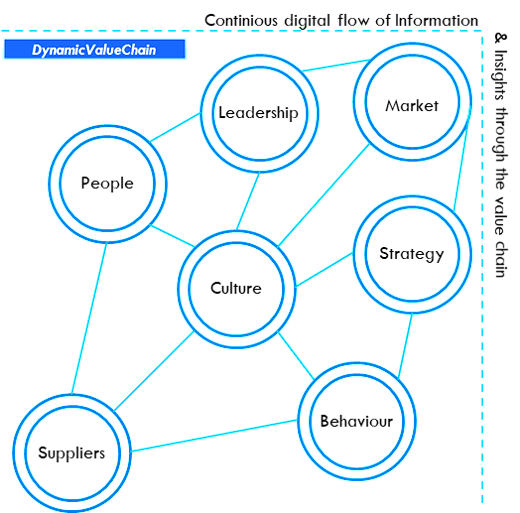
Today we celebrate the go-live of the DynamicValueChain.com website and the associated Blog. This blog services to spark discussion with the aim to deepen the thinking on how sustainable transformation can be achieved by addressing key elements of the Dynamic Value Chain. People | Behaviour | Culture | Thought Leadership | Customers | Strategy | Suppliers With the Ultimate aim to further define the concepts around Dynamic Value Chain thinking. All to be realized by meeting of minds in a collaborative setting with a passion for the concept and drive for enhancing the thinking around it.